Help
Help 
Yen’s sudden jumps stir talk of quiet intervention from Tokyo
The yen has started making abrupt, short-lived jumps against the dollar, and traders are paying close attention. The moves have revived speculation that Japanese authorities may be back in the market — not with the kind of large, headline-grabbing intervention seen before, but with smaller, quieter operations meant to warn investors that Tokyo is still watching and still willing to act.
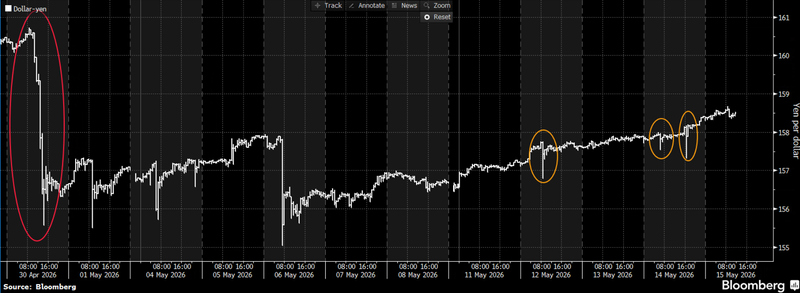
The yen has repeatedly spiked higher within minutes before quickly giving back those gains.
Traders suspect Japan may be using smaller operations to discourage another run above 160 per dollar.
There is no hard proof of fresh intervention, but the pattern has made bets against the yen more dangerous.
Some investors argue that even if authorities are acting, the moves may only be buying time.
The yen’s strange bursts higher are drawing attention
Every few sessions now, the yen suddenly snaps stronger against the dollar, only to fall back almost as quickly. The moves are brief, but they have become frequent enough to change the mood in the market.
That has opened up a familiar question: is Japan back in the market, trying to lean against yen weakness without saying so outright?
The answer is not clear. But in currency trading, certainty is not always required to change behavior. Sometimes suspicion is enough.
Why traders think Tokyo may be sending a message
The pattern has become hard to ignore. On Thursday, the yen jumped as much as 0.5% against the dollar in just two minutes during New York trading before giving up the move. A nearly identical surge happened on Tuesday. On May 8, there was another quick pop higher, though smaller.
Source: Bloomberg
None of those moves came with an official announcement. There were no public warnings from Japanese authorities, no obvious rate-check chatter across the market, and no decisive signal in Bank of Japan data. Still, traders are paying attention because the moves look deliberate enough to raise the possibility that Tokyo is trying to remind the market not to get too comfortable pushing dollar-yen higher.
The suspicion is simple: Japanese officials may be uneasy with the pair trading above 160 and may be trying to prevent another clean break in that direction.
Small operations can still have an effect
Even if the latest moves were not full-scale intervention, they may still have served a purpose. The mere sense that authorities could step in makes shorting the yen more complicated. Traders may still want to test Tokyo’s resolve, but they have to do it knowing they could be caught on the wrong side of a sudden move.
Japan has used this kind of layered strategy before. Large interventions have sometimes been followed by smaller operations designed to reinforce the signal. That happened in late 2022, when a relatively modest yen-buying move followed a much larger intervention aimed at slowing the currency’s slide.
That history is part of why the current jolts matter. They fit an old pattern, even if the evidence this time remains circumstantial.
The bigger interventions are still fresh in traders’ minds
The market has not forgotten what happened around Golden Week. People familiar with the matter said Japan intervened on April 30, and analysis of central-bank accounts suggests authorities may have spent around ¥10 trillion supporting the yen through the holiday period.
That is not small money. And it reinforces the idea that officials are still prepared to act when moves become too disorderly.
What the recent spikes may represent, then, is not a new campaign so much as a continuation of that posture — smaller warning shots after larger, more forceful action.
But the yen is still weak, and that raises doubts
The problem for Tokyo is that the underlying trend has not really changed. The yen was trading around 158.54 per dollar in Asia on Friday, weaker than its recent high of 155.04 on May 6. That has led some investors to question what the authorities have really achieved.
If these sudden bursts higher are indeed official in nature, they have not yet produced a lasting reversal. At best, they may be slowing the pace of the move. At worst, they are simply delaying another test of 160.
That is why some traders see the strategy less as a turning point and more as an attempt to buy time.
The market is left guessing, and that may be the point
One reason these moves are effective, at least in the short run, is precisely because they are ambiguous. If the finance ministry were openly warning every day or conducting obvious intervention, the market could begin to price that in more cleanly. But brief, unexplained spikes create uncertainty, and uncertainty itself can be a useful tool.
That uncertainty is now part of the trading environment. Whether the recent moves were intervention, rate checks, or simply nervous market positioning, the result is the same: traders are more cautious, and the cost of pressing yen weakness has gone up.
Warning shots may not reverse the trend
For now, that may be enough. These short, sharp moves are not strong enough to convince the market that the yen has turned. But they are strong enough to remind traders that betting against the currency is no longer a one-way trade.
And that may be exactly what Tokyo wants.
The finance ministry may not be trying to engineer a lasting rally in the yen just yet. It may simply be trying to make sure the market knows it is still there — and that pushing too hard above 160 could still come at a price.