
 Support

SpaceX stock falls for third day as $600 billion in market value vanishes
SpaceX shares fell for a third straight session, wiping out more than $600 billion in market value as investors reacted to the company’s first investment-grade bond sale and growing concerns over the cost of its artificial-intelligence expansion. The stock dropped 16% to $154.60, its lowest close since the first day of trading.

SpaceX shares fell 16% Monday to close at $154.60.
The stock is down 23% over three sessions.
More than $600 billion in market value has been erased.
SpaceX is seeking to raise at least $20 billion from its first bond offering.
SpaceX selloff deepens after post-IPO rally
SpaceX shares extended their decline for a third straight trading day, marking the sharpest setback since the company’s record public debut.
The stock dropped 16% on Monday to close at $154.60, its lowest level since SpaceX’s first day of trading. The decline pushed the three-day loss to 23% and erased more than $600 billion in market value over that period.
Even after the selloff, SpaceX remains one of the world’s largest public companies, with a market capitalization just above $2 trillion. The stock also remains about 15% above its $135 IPO price, showing that the company is still trading above its debut valuation despite the recent correction.
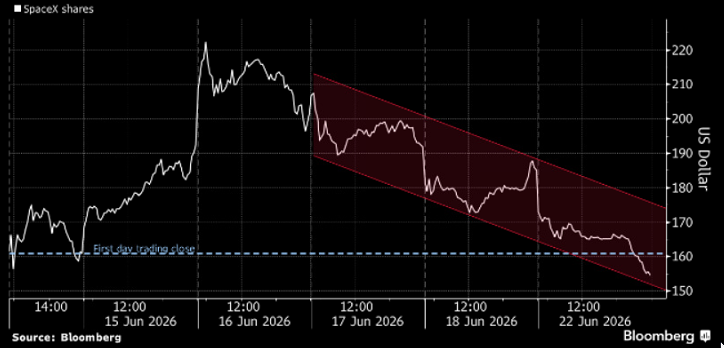
Source: Bloomberg
The move highlights how quickly sentiment can shift in a newly listed mega-cap stock, especially one that entered public markets with a limited float, intense retail demand and one of the most aggressive growth stories in the market.
Bond sale raises questions over AI spending
The latest pressure came after SpaceX said it is preparing to sell investment-grade bonds for the first time.
The company is seeking to raise at least $20 billion in its debut high-grade bond offering, with proceeds expected to help fund its artificial-intelligence ambitions. The move adds a new layer to the SpaceX investment story: investors are no longer only evaluating revenue growth and market opportunity, but also the balance-sheet cost of building a massive AI infrastructure business.
That matters because SpaceX has rapidly repositioned itself beyond rockets and satellites. After acquiring xAI in February, the company has leaned deeper into artificial intelligence, data infrastructure and computing capacity. Those opportunities may expand the long-term addressable market, but they also require enormous capital.
The bond sale suggests that SpaceX’s AI buildout may need significant external financing, even after its record $75 billion IPO.
Reflection AI deal adds to the AI infrastructure story
SpaceX also announced a multibillion-dollar agreement to provide computing resources to Reflection AI, an artificial-intelligence startup.
The deal reinforces SpaceX’s effort to turn its infrastructure into a revenue-generating AI platform. But it also comes at a time when investors are questioning how much spending will be required before those ambitions produce durable profits.
The company’s AI strategy has become central to its public-market valuation. SpaceX is no longer being treated as only a rocket-launch and satellite-internet business. Investors are also pricing expectations for data centers, compute services, AI models and future infrastructure tied to xAI.
That broader story helped fuel the IPO rally, but it is also making the stock more sensitive to concerns about borrowing, capital intensity and execution risk.
IPO volatility reflects limited float and retail demand
SpaceX’s first trading sessions have been unusually volatile.
Only 4.2% of total shares outstanding were available to trade on the first day, creating a low-float setup that can amplify price swings. At the same time, retail investors showed unusually strong demand for the stock.
Retail trading in SpaceX was the strongest of any IPO in recent history. Individual investors bought a net $405 million of SpaceX shares during the first five trading sessions. Retail buyers purchased more SpaceX last week than they bought across all Magnificent Seven stocks combined.
On Monday, retail traders were still net buyers of SpaceX, but inflows fell below the levels seen during the first week of trading. That slowdown matters because retail demand had been one of the strongest supports behind the early rally.
If retail buying continues to cool while institutions reassess valuation and debt plans, the stock may remain vulnerable to wider swings.
First hold-equivalent rating adds valuation pressure
Wall Street is also starting to frame the valuation debate more cautiously.
SpaceX received a sector-weight rating from KeyBanc Capital Markets, the first hold-equivalent rating tracked after the IPO. The view recognizes SpaceX’s leadership in space launch and adjacent markets, but also argues that much of the company’s long-term value is already reflected in the current stock price.
That is the core question for investors.
SpaceX has significant disruptive growth opportunities across launch services, Starlink, AI infrastructure, defense-related technology and computing resources. But after a record IPO and a rapid rise above the offering price, the market is now asking whether the valuation has already priced in too much of that future.
The recent selloff suggests investors are becoming more selective. Belief in the SpaceX story remains strong, but the stock now has to justify a valuation above $2 trillion while funding an expensive AI expansion.
What investors should watch next
The next phase of trading will likely depend on three factors: the bond sale, retail demand and the pace of AI monetization.
The bond offering will show how credit investors price SpaceX’s borrowing risk and how much confidence they have in the company’s cash-flow outlook. Strong demand for the debt could ease concerns. A difficult sale could deepen questions over funding costs.
Retail flows will also be important. If individual investors keep buying dips, the stock may find support. If retail enthusiasm fades, the low float could work in the opposite direction and amplify downside moves.
Finally, investors will want more detail on how SpaceX turns AI spending into revenue. Deals such as the Reflection AI agreement help, but the market will need evidence that computing resources, xAI integration and data-infrastructure investments can generate returns large enough to support the valuation.
SpaceX’s post-IPO rally is facing its first serious test.
The stock is still above its $135 IPO price and the company remains worth just over $2 trillion, but a 23% three-day drop and more than $600 billion in erased market value show that investors are no longer treating the story as risk-free.
The planned $20 billion bond sale has shifted attention from demand and hype to funding needs and capital intensity. SpaceX may still dominate space launch and carry one of the strongest AI-infrastructure narratives in the market, but public investors are now demanding more proof.
The IPO proved that investors wanted access to SpaceX. The bond sale and the stock’s first major correction will test how much they are willing to pay for the company’s next stage of growth.


